 |
 For a lifetime of learning fun! |
|
|
If you are unable to see the blue navigation
buttons below, go to Contents for text links.
| |
|
|
If you are unable to see the blue navigation
buttons below, go to Contents for text links.



































|
|
For a lifetime of learning fun! |
If you are unable to see the blue navigation
buttons below, go to Contents for text links.
 |
Reading/WritingReading 
| |||
|
If you are unable to see the blue navigation
buttons below, go to Contents for text links.
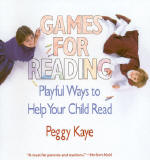 Games
for Reading: Playful Ways to Help Your Child Read by Peggy Kaye contains
some marvelously inventive games to fire a child's enthusiasm for reading. There
are bingo games, mazes, puzzles, games where the child acts silly, games for
parents, and more (over 70 games). These are quick, easy, and inexpensive using
materials easily found around the house. Games
for Reading: Playful Ways to Help Your Child Read by Peggy Kaye contains
some marvelously inventive games to fire a child's enthusiasm for reading. There
are bingo games, mazes, puzzles, games where the child acts silly, games for
parents, and more (over 70 games). These are quick, easy, and inexpensive using
materials easily found around the house. I've had several friends tell me that this book has given them many useful ideas. It helps to remember to keep the games fun and not get overly instructive. Designed for beginning readers. See also Kaye's books, Games for Math and Games for Writing. Paper, 213 pages. #1491 $17.95   |
|
Home |
Contents |
Contact Us |
Ordering/Shipping | Privacy
Statement |
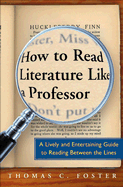
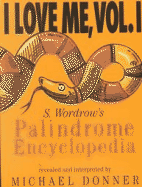 I
Love Me, Vol. I: S. Woodrow's Palindrome Encyclopedia by revealed
and interpreted by Michael Donner
-
For word lovers who crave the symmetrical, here are
a plethora of palindromes for places (Adavan, Hevada; Apollo, PA), people
(supermodel Aya, singer Ono, among others), things (a Toyota), classic
palindromes, and original palindromes. I
Love Me, Vol. I: S. Woodrow's Palindrome Encyclopedia by revealed
and interpreted by Michael Donner
-
For word lovers who crave the symmetrical, here are
a plethora of palindromes for places (Adavan, Hevada; Apollo, PA), people
(supermodel Aya, singer Ono, among others), things (a Toyota), classic
palindromes, and original palindromes. Arranged from aa (a type of lava) to Zzz-zzz-zzz (snoring), this book of many happy returns will have everybody reading not only between the lines, but north, south, east, and west along them. Paper, 400 pages. 7.8"x6"x1.2". #1090X $15.95
Out of print, one copy available. |
 Out of print, one copy available.
|
|
For a lifetime of learning fun! |
If you are unable to see the blue navigation
buttons below, go to Contents for text links.
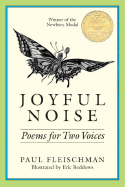 Joyful
Noise: Poems for Two Voices by Paul Fleischman. This slim volume of poems about
the insect world is wonderful! It is written to be read by two voices - sometimes
alternating, sometimes simultaneous. When first reviewing it, I had my husband sit down
with me to read it aloud to our two children. It was so much fun to read along with
another person, especially my husband (we'd never done anything like it before). Then
I read some poems with my son, a beginning reader. What a thrill! (I suppose we were also
doing what's called "choral reading.") Joyful
Noise: Poems for Two Voices by Paul Fleischman. This slim volume of poems about
the insect world is wonderful! It is written to be read by two voices - sometimes
alternating, sometimes simultaneous. When first reviewing it, I had my husband sit down
with me to read it aloud to our two children. It was so much fun to read along with
another person, especially my husband (we'd never done anything like it before). Then
I read some poems with my son, a beginning reader. What a thrill! (I suppose we were also
doing what's called "choral reading.") It's a fun way to read and a good introduction to poems (and to learn about bugs too). Winner of the 1989 Newbery Medal. Paper, 44 pages. #0932 $5.99
See Theoni Pappas' book
Math Talk for a similar book of math poems. |
|
Home |
Contents |
Contact Us |
Ordering/Shipping | Privacy
Statement |
Also by Paul Fleischman:
|
|
For a lifetime of learning fun! |
If you are unable to see the blue navigation
buttons below, go to Contents for text links.
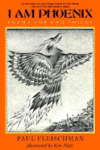
I am Phoenix: Poems for Two Voices In the same
format as Joyful Noise, the author celebrates the
essence of birds. A lovely book of poetry.
Paper, 64 pages.
#0924 $5.99
|
Home |
Contents |
Contact Us |
Ordering/Shipping | Privacy
Statement |
|
|
For a lifetime of learning fun! |
If you are unable to see the blue navigation
buttons below, go to Contents for text links.
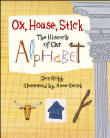 Ox,
House, Stick: The History of Our Alphabet by Don Robb, illustrated by
Anne Smith - In clear, straightforward prose, this book describes the
development of our Roman alphabet, from the early Semitic peoples, through the
Phoenicians and Greeks, to the letters we know today. You'll never look at ABC
the same way again! Ox,
House, Stick: The History of Our Alphabet by Don Robb, illustrated by
Anne Smith - In clear, straightforward prose, this book describes the
development of our Roman alphabet, from the early Semitic peoples, through the
Phoenicians and Greeks, to the letters we know today. You'll never look at ABC
the same way again!Paper, 48 pages. Ages 8-11. #6106 $7.95 "Smith's whimsical paintings are a fitting companion to Robb's lighthearted text. This quality work fills a significant gap in children's information literature. It should find a home in all collections." - School Library Journal starred review. |
|
Home |
Contents |
Contact Us |
Ordering/Shipping | Privacy
Statement |
|
|
For a lifetime of learning fun! |
If you are unable to see the blue navigation
buttons below, go to Contents for text links.
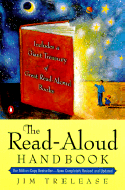 The Read-Aloud Handbook, 5th edition by Jim Trelease - Every child can become an avid reader and Jim Trelease shows how to make it happen. In this beloved, classic guide, Trelease shares his inspiring message, backed by delightful anecdotes as well as research. Includes a treasury featuring more than 1,500 children's book titles that are great for reading aloud - from picture books to novels. #1616
One copy available. |
|
Home |
Contents |
Contact Us |
Ordering/Shipping | Privacy
Statement |
|
|
For a lifetime of learning fun! |
If you are unable to see the blue navigation
buttons below, go to Contents for text links.
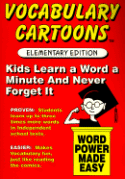 Vocabulary Cartoons: Elementary Edition by
Sam, Max and Bryan Burchers - Learn new words and retain them through mnemonics!
"A mnemonic (NEH mon ik) is a fancy word which simply means 'assisting' the
memory.' Memory experts tell us that mnemonics are just about the best way to
remember anything." Vocabulary Cartoons: Elementary Edition by
Sam, Max and Bryan Burchers - Learn new words and retain them through mnemonics!
"A mnemonic (NEH mon ik) is a fancy word which simply means 'assisting' the
memory.' Memory experts tell us that mnemonics are just about the best way to
remember anything." This book uses both rhyming and visual mnemonics. A rhyming mnemonic is simply a "word association where you rhyme a word you want to learn with a word you already know." A visual mnemonic uses pictures. Since you can't make pictures of many words in our vocabulary (such as novelty), you use a substitute word instead. The visuals this book uses are cartoons and the associations are often quite funny. Example: the word "nourish," which means to help grow or develop. The book uses a cartoon of a nurse feeding a patient, with the line below the cartoon saying "a nurse's job is to nourish the sick." There are then several other sentences using the word "nourish." Large print. Paper, 250 pages. #2233 $12.95
There are two other
Vocabulary Cartoons books for older kids, as well.
Yo Millard
Fillmore also uses mnemonics. |
|
Home |
Contents |
Contact Us |
Ordering/Shipping | Privacy
Statement |
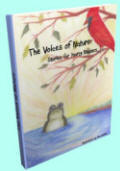 The
Voices of Nature: Stories for Young Readers illustrations by Ana Spotts
- Ana Spotts drew all the wonderful illustrations in this book for her high
school Senior Project at The Denver Waldorf School. Each drawing brings to life
what animals do and how they play in nature. These stories were carefully
selected because they are easy for the young reader and they depict the
wonderment of nature and its enchanting forms of expression and voices.
New Release.
The
Voices of Nature: Stories for Young Readers illustrations by Ana Spotts
- Ana Spotts drew all the wonderful illustrations in this book for her high
school Senior Project at The Denver Waldorf School. Each drawing brings to life
what animals do and how they play in nature. These stories were carefully
selected because they are easy for the young reader and they depict the
wonderment of nature and its enchanting forms of expression and voices.
New Release.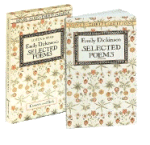 Listen & Read Best-Loved Poems and Emily Dickinson's
Selected Poems (2 books/cassettes, published by Dover) -
These two boxed sets include both a book and a cassette. Listen & Read Best-Loved Poems and Emily Dickinson's
Selected Poems (2 books/cassettes, published by Dover) -
These two boxed sets include both a book and a cassette.
Best-Loved Poems includes some of the finest and most-loved poems in the English language, from the Renaissance to the 20th century, beautifully read by stage actor Earl Hammond. There is one 60-minute audio cassette featuring 36 great poems and a paperback edition of 100 Best-Loved Poems edited by Philip Smith containing all of the poems on the cassette plus many more selections. Emily Dickinson's Selected Poems presents the poetry of one of America's greatest and most popular poets. Included in the set is one 65-minute audio cassette featuring 101 of Dickinson's finest poems, read by actress Marian Seldes and a paperback edition of the poems. When I was 12 years old, my mom was a Scout leader. When checking out a possible campground for the scouts as a spring activity (in the middle of winter), I discovered a copy of a poetry book in the snow. As a book-lover, this was a magical experience. I soon came to love several of the poems and to this day that slim volume has an honored place on my bookshelf. Worn, tattered, and with an old inscription from the original owner, the books contains poems that still bring tears to my eyes. #FUN100 $11.90
2 books & 2 cassettes. Out of print - one set available.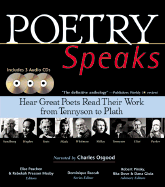 Poetry
Speaks: Hear Great Poets Read Their Work From Tennyson to Plath (Book and 3
Audio CDs) edited by Elise Paschen & Rebekah
Presson Mosby, narrated by Charles Osgood.
Combining the talents of great
poets past and living, their words written and spoken, this collection features
the authors themselves reading their poetry on audio
CD. Contributors range from Alfred, Lord Tennyson to Sylvia Plath and Langston
Hughes. Additional poems in print form allow the reader to further explore the
poets' works. Poetry
Speaks: Hear Great Poets Read Their Work From Tennyson to Plath (Book and 3
Audio CDs) edited by Elise Paschen & Rebekah
Presson Mosby, narrated by Charles Osgood.
Combining the talents of great
poets past and living, their words written and spoken, this collection features
the authors themselves reading their poetry on audio
CD. Contributors range from Alfred, Lord Tennyson to Sylvia Plath and Langston
Hughes. Additional poems in print form allow the reader to further explore the
poets' works.Included is a never-before-published recording of Alfred, Lord Tennyson reading "The Charge of the Light Brigade," W.B. Yeats explaining his reading "style" and why he chooses to read that way, and Robert Frost reading "The Road Not Taken" and "Stopping by Woods on a Snowing Evening". Hardcover, 352 pages. 3 audio CDs. #7206 $49.95
One copy available. |
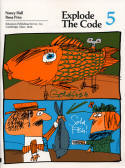 Explode
the Code 5 introduces students to the word
endings -ed and -ey, word families including all-alk,
old-olt-oll, ild-ind, the digraph qu,
and 3-letter blends. Students practice blending sounds to read and write
multi-syllabic words. In addition, several review lessons are included.
Explode
the Code 5 introduces students to the word
endings -ed and -ey, word families including all-alk,
old-olt-oll, ild-ind, the digraph qu,
and 3-letter blends. Students practice blending sounds to read and write
multi-syllabic words. In addition, several review lessons are included.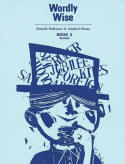 Wordly Wise
 Wordly Wise, Book 2 is made up of 30
lessons with approximately 12 words in each lesson. Words taught in Book 2
include sullen, adequate, churn, perplexed, zeal, brine, hectic, impetuous,
nape, calamity, frugal, tableau, retain, and essential. Comprehension of the
vocabulary words is facilitated and reinforced through the four different
exercises repeated in each lesson and the chapter reviews. Grade 5. Workbook and answer
key.
#WW2 $19.95 $14.99
|
|
For a lifetime of learning fun! |
If you are unable to see the blue navigation
buttons below, go to Contents for text links.
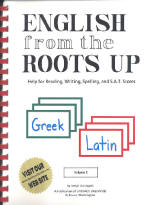 English
from the Roots Up, Vol I: Help for Reading, Writing, Spelling and S.A.T. scores
by Joegil Lundquist. If you are interested in learning important Greek and Latin
roots, without studying the entire Latin language, English from the Roots Up
is for you. It uses 63 Latin and 37 Greek root words. Included is a
pronunciation guide, and a neat little explanation of Roman numerals (now you
can translate the darn numbers at the end of movies!) My husband, Bill, took
Latin in high school and says it helped him with English and prepared him for
all the science classes he took as a biology major in college. Paper, 125 pages,
Ages 7-adult. You may also be interested in the cards
that go with this book and Volume II of the series). English
from the Roots Up, Vol I: Help for Reading, Writing, Spelling and S.A.T. scores
by Joegil Lundquist. If you are interested in learning important Greek and Latin
roots, without studying the entire Latin language, English from the Roots Up
is for you. It uses 63 Latin and 37 Greek root words. Included is a
pronunciation guide, and a neat little explanation of Roman numerals (now you
can translate the darn numbers at the end of movies!) My husband, Bill, took
Latin in high school and says it helped him with English and prepared him for
all the science classes he took as a biology major in college. Paper, 125 pages,
Ages 7-adult. You may also be interested in the cards
that go with this book and Volume II of the series). #1033 $29.95
|
|
If you are unable to see the blue navigation
buttons below, go to Contents for text links.
|
English from the Roots Up word cards
(for Vol I)- You can make your own cards to accompany the above book, but everyone I know
prefers to use this pre-made set of cards for 100 Latin and Greek words. #2135 $18.00 |
|
Home |
Contents |
Contact Us |
Ordering/Shipping | Privacy
Statement |
English
from the Roots Up, Vol 1 Book & Word Cards FUNPak - English from the Roots Up, Vol 1 and one
set of the English from the Roots Up word cards for Volume 1. #FUN71
$47.95 $37.99
|
Home |
Contents |
Contact Us |
Ordering/Shipping | Privacy
Statement |
|
|
For a lifetime of learning fun! |
If you are unable to see the blue navigation
buttons below, go to Contents for text links.
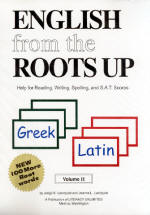 English
from the Roots Up, Volume II by Joegil Lundquist- The long-awaited
second volume of EFTRU is finally here! Continuing the popular program begun in
Volume I, this book gives you 100 new Greek and Latin
root words to learn. The new words are a little more advanced than those in the
Volume I edition, but are still easy enough for young learners. Many of the
lessons also refer to lessons already presented in Volume I. A new feature in
this volume: pronunciation guidance for Latin and Greek words on every page. In
additions to more advanced content, there are also new activities. You do not
need a background in Latin to learn or teach this program. Paper, 107 pages.
Ages 9-adult. English
from the Roots Up, Volume II by Joegil Lundquist- The long-awaited
second volume of EFTRU is finally here! Continuing the popular program begun in
Volume I, this book gives you 100 new Greek and Latin
root words to learn. The new words are a little more advanced than those in the
Volume I edition, but are still easy enough for young learners. Many of the
lessons also refer to lessons already presented in Volume I. A new feature in
this volume: pronunciation guidance for Latin and Greek words on every page. In
additions to more advanced content, there are also new activities. You do not
need a background in Latin to learn or teach this program. Paper, 107 pages.
Ages 9-adult.#2311 $29.95
|
|
If you are unable to see the blue navigation
buttons below, go to Contents for text links.
|
English from the Roots Up Word Cards
(for Vol II)- You can make your own cards to accompany the above book, but everyone I know
prefers to use this pre-made set of cards for 100 Latin and Greek words. #2296 $18.00 |
|
Home |
Contents |
Contact Us |
Ordering/Shipping | Privacy
Statement |
English
from the Roots Up, Vol II Book & Word Cards FUNPak - English from the Roots Up, Vol
II and one
set of the English from the Roots Up Word Cards for Volume II. #FUN72
$47.95 $37.99
English from the Roots Up Volumes I & II FUNPak Buy both books (Volumes I & II) and
save even more!
#FUN38 $59.90 $49.99
English from the Roots Up Whole Shebang FUNPak - Buy both books
(Volumes I & II) and both sets of Word Cards (Volumes I & II) and receive your
best savings. #FUN73 $95.90
$71.99
|
Home |
Contents |
Contact Us |
Ordering/Shipping | Privacy
Statement |
|
|
For a lifetime of learning fun! |
If you are unable to see the blue navigation
buttons below, go to Contents for text links.
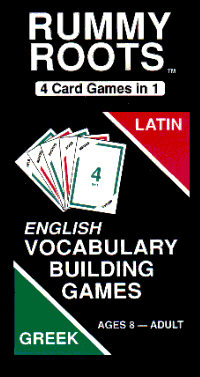 Rummy
Roots: English Vocabulary Building Games - Our whole family had fun with this
card game. After playing, the kids became very aware of all the words in our language that
are based on Greek and Latin. "Hey, mom, bicycle-tricycle, two wheels-three
wheels!" Exclamations like that would come from the back seat of our car on the way
to the post office or from the kitchen table as we ate breakfast. It is designed for 2-4
players, ages 8-adult (our 6-year old played, with help. We also copied the vocabulary
list so everyone could have one for reference).
Rummy
Roots: English Vocabulary Building Games - Our whole family had fun with this
card game. After playing, the kids became very aware of all the words in our language that
are based on Greek and Latin. "Hey, mom, bicycle-tricycle, two wheels-three
wheels!" Exclamations like that would come from the back seat of our car on the way
to the post office or from the kitchen table as we ate breakfast. It is designed for 2-4
players, ages 8-adult (our 6-year old played, with help. We also copied the vocabulary
list so everyone could have one for reference).
Rummy Roots teaches 42 Greek and Latin roots, alphabetizing, dictionary
skills, vocabulary and
more using rules based on popular card games like Go Fish. It is fun and challenging, and there are several games on different
levels. Play is enhanced by combining Rummy Roots with More Rummy Roots (see
below).
Ages 8-adult. For 2-4 players.
Rummy Roots #RR1 $15.95
Out of stock.
More Roots:
English Vocabulary Building Games - Ready to learn more? More Roots continues along in the same format as
Rummy Roots (above) and
introduces new Greek & Latin roots to increase your knowledge and skill
level.
There are several games on various levels so it's fun for a variety of ages and
abilities.
Ages 8-adult. For 2-4 players.
More Roots #MRR $15.95
|
Home |
Contents |
Contact Us |
Ordering/Shipping | Privacy
Statement |
|
|
For a lifetime of learning fun! |
If you are unable to see the blue navigation
buttons below, go to Contents for text links.
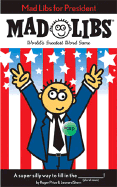 Mad Libs by Stern & Price Mad Libs by Stern & PriceI remember having fun with Mad Libs when I was child (several decades ago),and I still have loads of fun creating zany sentences with my children and their friends. Each Mad Libs book is composed of one-page stories that contain blank spaces where words are left out. The person(s) in possession of the book asks other players to give him words (nouns, verbs, adjectives, adverbs, etc.) without them knowing the story. He then reads the story aloud with their words filled in. Kids and adults love the silly results. It’s a fun AND easy way to learn parts of speech. Other aspects we like: * It’s a fun ice-breaker for social gatherings. * You don’t need to read lots of instructions before playing. * It’s very transportable and great for car trips! * It’s fun for multiple age levels (see below for Mad Libs Junior) * Great as a party game or to give away as a party favor * Even though it’s great to play with others, you can play on your own if you don’t pay attention to the sentences until after you fill in the parts of speech. * You can reuse the books (use a pencil and erase original results) Paper, 48 pages.
|
|
Home |
Contents |
Contact Us |
Ordering/Shipping | Privacy
Statement |
|
|
For a lifetime of learning fun! |
If you are unable to see the blue navigation
buttons below, go to Contents for text links.
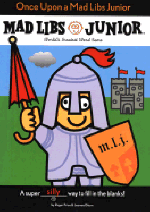 Mad Libs Junior Mad Libs Junior
Featuring the same fun humor as the original series, Mad Libs Junior is tailored for the younger reader. “Each puzzle includes four categories of words to choose from, indicated by a distinct symbol. Each symbol represents a part of speech and a list of words is offered. To play, kids are told the category from which to pick a word, including categories such as nouns, adjectives, verbs and miscellaneous.” Compared to the regular Mad Libs series, Mad Libs Junior books are larger, the font (text) is bigger, and a larger space to fill in the blanks is left for beginning writers. The publisher recommends these for ages 5-8, though some 8 year-olds might find the format too childish (for instance if they don't like books with large font sizes). The regular Mad Libs books are perfectly fine for young children, especially if an older child or adult is participating. The junior books may be more helpful for the younger child if they want to independently read the material aloud to others and fill in the blanks themselves and may cover subject material that is more interesting to a young person. Paper, 48 pages.
|
|
Home |
Contents |
Contact Us |
Ordering/Shipping | Privacy
Statement |
 The
Bedford Guide for College Writers with Reader and Research Manual, 6th edition by
X.J. Kennedy, Dorothy M. Kennedy and Sylvia A. Holladay is three coordinated
books in one. A Writer's Guide offers step-by-step instruction and
plenty of models for writing the essays most commonly assignd in a first-year
composition course. A Writer's Reader is a collection of thirty-three
readings about
body
image, the workplace, popular culture, and other engaging topics. Finally, A
Writer's Research Manual provids help with writing from sources and
includes updated guidelines for using electronic sources effectively. The
Bedford Guide for College Writers with Reader and Research Manual, 6th edition by
X.J. Kennedy, Dorothy M. Kennedy and Sylvia A. Holladay is three coordinated
books in one. A Writer's Guide offers step-by-step instruction and
plenty of models for writing the essays most commonly assignd in a first-year
composition course. A Writer's Reader is a collection of thirty-three
readings about
body
image, the workplace, popular culture, and other engaging topics. Finally, A
Writer's Research Manual provids help with writing from sources and
includes updated guidelines for using electronic sources effectively.Paper, 722 pages. 7.25"x9.25"x1". #2907 $55.00 $49.99 |
|
|
For a lifetime of learning fun! |
If you are unable to see the blue navigation
buttons below, go to Contents for text links.
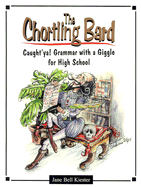 The Chortling Bard: Caught'ya! Grammar with a
Giggle for High School (A
Method for Teaching Grammar, Mechanics, Usage, Vocabulary, and Literary Devices
with Plots and Vocabulary Borrowed from Shakespeare)
by Jane Bell Kiester -
Created
to meet the special needs of high school teachers, this resource transforms
three of Shakespeare's comedies into challenging and humorous daily doses of
grammar, usage, mechanics, vocabulary, and literary devices. Easy to adapt,
The Chortling Bard supplies three years' worth of sentences, texts, and
keys, and a complete grammar reference. The Chortling Bard: Caught'ya! Grammar with a
Giggle for High School (A
Method for Teaching Grammar, Mechanics, Usage, Vocabulary, and Literary Devices
with Plots and Vocabulary Borrowed from Shakespeare)
by Jane Bell Kiester -
Created
to meet the special needs of high school teachers, this resource transforms
three of Shakespeare's comedies into challenging and humorous daily doses of
grammar, usage, mechanics, vocabulary, and literary devices. Easy to adapt,
The Chortling Bard supplies three years' worth of sentences, texts, and
keys, and a complete grammar reference.Paper, 240 pages. 10.9 x 8.5 x 0.6. #5258 $21.95
One copy available. |
|
Home |
Contents |
Contact Us |
Ordering/Shipping | Privacy
Statement |
|
|
For a lifetime of learning fun! |
If you are unable to see the blue navigation
buttons below, go to Contents for text links.
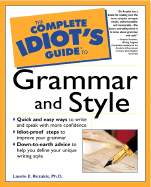 The
Complete Idiot's Guide to Grammar and Style, second edition by Laurie E.
Rozakis, Ph.D. -
With this guide you'll gain what
you need to be a great communicator at home and on the job. It provides solid
information on grammatical rules and how and when to use them, friendly advice
for adding variety and style to your writing, and tips, definitions, and
warnings to help you along the way. The
Complete Idiot's Guide to Grammar and Style, second edition by Laurie E.
Rozakis, Ph.D. -
With this guide you'll gain what
you need to be a great communicator at home and on the job. It provides solid
information on grammatical rules and how and when to use them, friendly advice
for adding variety and style to your writing, and tips, definitions, and
warnings to help you along the way. It will take you step-by-step through the basics of spelling, punctuation, and sentence formation. You also get: explanations of writing styles, definitions of writing mistakes and how to avoid them, examples of model documents (such as resumes, cover letters, and thank you notes), and the differences between drafting a business letter and crafting a personal one. Paper, 432 pages. 9.25"x7.5"x1". #1158 |
|
Home |
Contents |
Contact Us |
Ordering/Shipping | Privacy
Statement |
|
|
For a lifetime of learning fun! |
If you are unable to see the blue navigation
buttons below, go to Contents for text links.
 Creating
Writers Through 6-Trait Writing Assessment and Instruction, 3rd edition
by Vicki Spandel
offers a comprehensive overview
of the best education strategies and philosophies of writing assessment and
instruction. It provides clear guidelines to students on how to draft, assess,
and revise their writing. Designed for teachers. Creating
Writers Through 6-Trait Writing Assessment and Instruction, 3rd edition
by Vicki Spandel
offers a comprehensive overview
of the best education strategies and philosophies of writing assessment and
instruction. It provides clear guidelines to students on how to draft, assess,
and revise their writing. Designed for teachers.Paper, 416 pages. 9.25"x7.5"x.75". #2524 |
|
Home |
Contents |
Contact Us |
Ordering/Shipping | Privacy
Statement |
|
|
For a lifetime of learning fun! |
If you are unable to see the blue navigation
buttons below, go to Contents for text links.
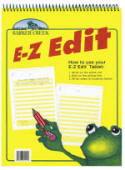 E-Z Edit Tablet - Designed by a professional journalist, this tablet makes it easy to help students strengthen their writing skills. The pages in this 50-page tablet have alternating white and yellow lines. The students write on the white lines, the “editors” (teachers, parents, fellow students, etc.) make their comments on the yellow lines. There is a yellow box on the bottom of each page for detailed explanations and helpful tips. And, because the lines are numbered, it’s easy to reference a comment back to a specific sentence on the page. All of the pages in the E-Z Edit tablet are perforated at the top and three-hole punched along the side so they can be easily removed and placed in a three-ring binder. #5502 $4.99 |
|
Home |
Contents |
Contact Us |
Ordering/Shipping | Privacy
Statement |
 |
 480
pages; reproducibleonly
28 prepositions introduced materials
presented in an easy, step-by-step
480
pages; reproducibleonly
28 prepositions introduced materials
presented in an easy, step-by-step  manner;
easy readingpre/post
assessmentage-appropriate,
interesting worksheets Writing
section includes how to write items in a series
and appositivescontains
unit reviews, tests, cumulative reviews, and
cumulative testsreproducible
worksheets (answer key on left side and reproducible page on
right)Tests
are also in the teacher edition.
manner;
easy readingpre/post
assessmentage-appropriate,
interesting worksheets Writing
section includes how to write items in a series
and appositivescontains
unit reviews, tests, cumulative reviews, and
cumulative testsreproducible
worksheets (answer key on left side and reproducible page on
right)Tests
are also in the teacher edition.
#1420 $27.95 $19.99
One copy available.
Easy
Grammar: Grade 3 Student Test Booklet
64 pages.
#1499 $4.95
One copy available.
Easy
Grammar: Grade 5 Teacher Edition - Students are asked to delete
prepositional phrases in order to help understand other concepts.
In
addition to grammar concepts, capitalization, punctuation, sentence types,
phrases/clauses and friendly/business letters are included. Ample practice
worksheets are offered for each skill.
 |
53
prepositions introduced
materials
presented and reviewed throughout
contains
unit reviews, unit tests, cumulative reviews,
and
cumulative tests
includes
pre/post assessments
reproducible
worksheets (answer key on left side
and
reproducible page on right)
writing
section "teaches" how to write appositives, semicolon construction, and compound
sentences
See
"Scope and Sequence" for content.
Tests
are also in the teacher edition.
#1413 $34.95
$24.99
Easy Grammar Plus teacher edition - is a non-grade level text; therefore, it has wide application. Although the text is ideal for seventh grade, it is used by various middle schools (junior highs), high schools, and in some colleges.
 |
non-grade
level (junior high through adult) contains
additional higher level concepts such as gerunds plus the
perfect and progressive tenses includes
more difficult capitalization and punctuation rules unit
reviews, unit tests, cumulative reviews, andcumulative
tests 665
pages
See
"Scope and Sequence" for content.
reproducible
worksheets (answer key on left side and reproducible page on right)
Tests
are also in the teacher edition.
#1130 $32.95
$24.99
One copy available.
|
|
For a lifetime of learning fun! |
If you are unable to see the blue navigation
buttons below, go to Contents for text links.
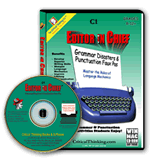 Editor
in Chief C1 Software (Critical Thinking Press) - Editor in Chief
improves your child's grammar, punctuation, spelling, capitalization, and
attention to detail using a standards-based thinking approach rather than drill
and practice. This effective method teaches students to carefully analyze and
edit stories that contain errors in writing mechanics and story details. Editor
in Chief C1 Software (Critical Thinking Press) - Editor in Chief
improves your child's grammar, punctuation, spelling, capitalization, and
attention to detail using a standards-based thinking approach rather than drill
and practice. This effective method teaches students to carefully analyze and
edit stories that contain errors in writing mechanics and story details.The stories involve mixed-skills practice, starting with easier errors and becoming more challenging as students become adept at the editing process. The books and software both use the same stories, errors, and rules. The difference is in the way students edit the stories. Students identify and click on errors in each story. Then they select the category and specific rule that applies to each error, prompting the software to correct the error. On-screen instructions, hints, rules, and answers allow students to work, learn, and succeed independently. Features: Provides high-quality independent learning (not "edutainment") with immediate feedback for students and parents. 33 activities Beginning, intermediate, and advanced levels of play. Quick and detailed instructions Hints that help students keep learning even if they don't know a rule-no getting stuck. Guide to grammar, usage & punctuation that teaches and reinforces concepts Saves unfinished games Self-grading, with printable student data System Requirements: Platform: XP/2000/ Me/NT/98/95 Media: CD-ROM CPU: 200 MHz or faster RAM: 32MB Platform: Macintosh OS X/OS 9-7.5 Media: CD-ROM CPU: 200 MHz or faster RAM : 32MB #6920 |
|
Home |
Contents |
Contact Us |
Ordering/Shipping | Privacy
Statement |
|
|
For a lifetime of learning fun! |
If you are unable to see the blue navigation
buttons below, go to Contents for text links.
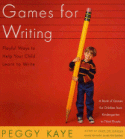 Games
for Writing: Playful Ways to Help Your Child Learn to Write by Peggy
Kaye. As with the author's other books, the games in this book are easy,
inexpensive, and fun. She covers handwriting, creative writing, spelling, and
grammar through the use of more than fifty activities (mazes, baking pretzels,
and playing rhyming games are just a few.)
Games
for Writing: Playful Ways to Help Your Child Learn to Write by Peggy
Kaye. As with the author's other books, the games in this book are easy,
inexpensive, and fun. She covers handwriting, creative writing, spelling, and
grammar through the use of more than fifty activities (mazes, baking pretzels,
and playing rhyming games are just a few.)
Lists of spelling words and books to read, and a chart listing games by age
level are included.
Paper, 213 pages. See also Kaye's
books, Games for Reading and
Games for Math.
#4270 $17.00
|
Home |
Contents |
Contact Us |
Ordering/Shipping | Privacy
Statement |
|
|
For a lifetime of learning fun! |
If you are unable to see the blue navigation
buttons below, go to Contents for text links.
 Great
Explorations in Editing, Volume I - Learners learn and review
writing skills and grammar as they search for the errors in each written
passage: Great
Explorations in Editing, Volume I - Learners learn and review
writing skills and grammar as they search for the errors in each written
passage:Editing exercises teach learners to identify and use the techniques of good writing. Specific skills are defined, utilized, and reviewed, with many examples. A complete glossary of writing skills are included, plus vocabulary and more. Two separate sections: A Lesson in History and Amazing Facts. A total of 90 lessons. Paper, 108 pages. 8.5"x11" #2794 $15.00 |
|
Home |
Contents |
Contact Us |
Ordering/Shipping | Privacy
Statement |
|
|
For a lifetime of learning fun! |
If you are unable to see the blue navigation
buttons below, go to Contents for text links.
Handwriting, Early Skills (World's #1 Quick Reference Guides) by Barcharts - A single, double-sided laminated page. 8.5"x11.5". Contains tips for teaching beginning writing skills. #3634
One copy available. |
|
Home |
Contents |
Contact Us |
Ordering/Shipping | Privacy
Statement |
 Hodges' Harbrace Handbook (15th edition) - Improve
your writing skills with Hodges Harbrace Handbook. Learn how to write
effectively, how to choose the most effective information, how to arrange it
effectively, and how to decide on the most appropriate language to use when
writing for a particular audience. This grammar-first handbook comprehensively
covers information that is crucial to a successful college career-grammar,
style, punctuation, and mechanics. Authors Glenn/Miller/Webb/Gray.
One copy available.
Hodges' Harbrace Handbook (15th edition) - Improve
your writing skills with Hodges Harbrace Handbook. Learn how to write
effectively, how to choose the most effective information, how to arrange it
effectively, and how to decide on the most appropriate language to use when
writing for a particular audience. This grammar-first handbook comprehensively
covers information that is crucial to a successful college career-grammar,
style, punctuation, and mechanics. Authors Glenn/Miller/Webb/Gray.
One copy available.|
|
For a lifetime of learning fun! |
If you are unable to see the blue navigation
buttons below, go to Contents for text links.
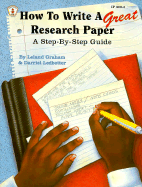 How
to Write a Great Research Paper: A Step-by-Step Guide by Leland Graham &
Darriel Ledbetter is a practical, comprehensive manual that guides learners
step-by-step through the research process. The book uses friendly language to
carefully explain all aspects of planning, researching, and writing the paper. How
to Write a Great Research Paper: A Step-by-Step Guide by Leland Graham &
Darriel Ledbetter is a practical, comprehensive manual that guides learners
step-by-step through the research process. The book uses friendly language to
carefully explain all aspects of planning, researching, and writing the paper.
Topics include: choosing and narrowing an appropriate topic, obtaining the needed information from the library, taking notes, organizing notes into a coherent outline, properly documenting sources, writing and revising the first draft, writing the final draft, and evaluating the final paper. Written for ages 11-14, though it certainly could be adapted for an older learner. Paper, 96 pages. 11.1 x 8.6 x 0.3. #2529
Out of print; one copy available. |
|
Home |
Contents |
Contact Us |
Ordering/Shipping | Privacy
Statement |
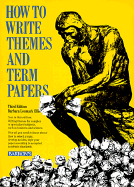 How
to Write Themes and Term Papers, 3rd edition by Barbara Lenmark
Ellis guides secondary school and college students in preparing basic writing
assignments and term papers. It also instructs on writing the latest
college-admission essays. Advice includes
How
to Write Themes and Term Papers, 3rd edition by Barbara Lenmark
Ellis guides secondary school and college students in preparing basic writing
assignments and term papers. It also instructs on writing the latest
college-admission essays. Advice includes
 Out of print, one copy available.
|
|
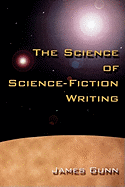 The
Science of Science-Fiction Writing by James Gunn -
Written by one of the leading authorities on writing, publishing and teaching
science fiction, The Science of Science Fiction Writing offers the opportunity
to share in the knowledge James Gunn has acquired over the past forty years. He
reflects on the fiction-writing process and how to teach it, and the ideas he
has shared with his students about how to do it effectively and how to get it
published afterwards. The
Science of Science-Fiction Writing by James Gunn -
Written by one of the leading authorities on writing, publishing and teaching
science fiction, The Science of Science Fiction Writing offers the opportunity
to share in the knowledge James Gunn has acquired over the past forty years. He
reflects on the fiction-writing process and how to teach it, and the ideas he
has shared with his students about how to do it effectively and how to get it
published afterwards.The first section discusses why people read fiction, the parts of the short story, the strategy of the science fiction author, scene as the smallest dramatic unit, how to speak well in print, suspense in fiction, how to say the right thing, and how to give constructive criticism. The second section takes a more philosophical approach. Here, Gunn elaborates on the origins of science fiction, its definition, the worldview of science fiction, and the characters that appear in science fiction novels. The third section highlights well-known sci-fi authors: H.G. Wells, Robert A. Heinlein, Isaac Asimov, Henry Kuttner, C.L. Moore, and others, and the impact they have had on the development and progression of science fiction. Paper, 256 pages. 9"x6"x.7". A more recent printing of the book retails for $26.35. This copy is an earlier printing that cost less, but it is exactly the same edition. #0111 $14.95
One copy available. |
|
|
For a lifetime of learning fun! |
If you are unable to see the blue navigation
buttons below, go to Contents for text links.
 The 3
R's
by Ruth Beechick. Designed for grades K-3, this useful package includes three
booklets: A Home Start in Reading, A Strong Start in Language, An Easy Start in
Arithmetic. Also included is a reversible wall chart that includes a hundreds chart and
phonics information. Excellent!
The 3
R's
by Ruth Beechick. Designed for grades K-3, this useful package includes three
booklets: A Home Start in Reading, A Strong Start in Language, An Easy Start in
Arithmetic. Also included is a reversible wall chart that includes a hundreds chart and
phonics information. Excellent!
Paper.
#9063 $12.00 $10.99
|
Home |
Contents |
Contact Us |
Ordering/Shipping | Privacy
Statement |
|
|
For a lifetime of learning fun! |
If you are unable to see the blue navigation
buttons below, go to Contents for text links.
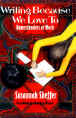 Writing Because
We Love To: Homeschoolers at Work by Susannah Sheffer, editor of
Growing Without Schooling, Through her work with homeschoolers ages 10-15,
the author explores how to help kids with their writing and looks at what
children do when they are in charge of their own learning. Provides many
examples of young writers' work and their reflections on it. Writing Because
We Love To: Homeschoolers at Work by Susannah Sheffer, editor of
Growing Without Schooling, Through her work with homeschoolers ages 10-15,
the author explores how to help kids with their writing and looks at what
children do when they are in charge of their own learning. Provides many
examples of young writers' work and their reflections on it. This book is out of print, but we have some used copies. They may have creases, library marks, or highlights. Paper, 122 pages. #3013 $18.99 |
|
Home |
Contents |
Contact Us |
Ordering/Shipping | Privacy
Statement |
|
|
For a lifetime of learning fun! |
If you are unable to see the blue navigation
buttons below, go to Contents for text links.
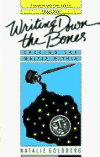
Writing Down the Bones: Freeing the Writer Within by Natalie Goldberg is a great
book about writing, but it is also about how to use writing to gain understanding about
one's self. The author writes "what is said here about writing can be applied to
running, painting, anything you love and have chosen to work within your life."
Paper, 171 pages
#3759 $12.95 $10.35
|
Home |
Contents |
Contact Us |
Ordering/Shipping | Privacy
Statement |
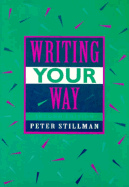 Writing
Your Way, Second Edition by Peter Stillman -
By inviting students to write from their
experiences and intuitions, thus making the most of their willingness to put
something of themselves on paper, Writing Your Way makes better, even
eager, writers out of all students. Writing
Your Way, Second Edition by Peter Stillman -
By inviting students to write from their
experiences and intuitions, thus making the most of their willingness to put
something of themselves on paper, Writing Your Way makes better, even
eager, writers out of all students.Stillman's approach is emphatically process orientd, stressing prewriting, revision, and work in peer writing groups. Since learning to write requires continual practice in writing, there are opportunities in each of the twenty-six chapters to write and discover the process that best suits the individual. Writing becomes an everyday act that can be gratifying on both a personal and an academic level. Paper, 174 pages. Young adult. #3439 |
|
|
For a lifetime of learning fun! |
If you are unable to see the blue navigation
buttons below, go to Contents for text links.
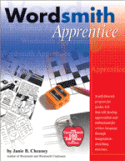 Wordsmith
Apprentice by Janie Cheaney - All the practicality, humor and fun of
Wordsmith, but written for the younger student, ages 9-12. An easy to
use writing course encouraging students to develop their writing skills as they
participate in every role on a newspaper staff: editor, reporter, writer, etc.
Children develop a love for writing as they express themselves through sentence
and paragraph writing, persuasive writing, and much more. Wordsmith
Apprentice by Janie Cheaney - All the practicality, humor and fun of
Wordsmith, but written for the younger student, ages 9-12. An easy to
use writing course encouraging students to develop their writing skills as they
participate in every role on a newspaper staff: editor, reporter, writer, etc.
Children develop a love for writing as they express themselves through sentence
and paragraph writing, persuasive writing, and much more. Paper, 126 pages. Spiral-bound. #3178 $16.00 |
|
Home |
Contents |
Contact Us |
Ordering/Shipping | Privacy
Statement |
|
|
For a lifetime of learning fun! |
If you are unable to see the blue navigation
buttons below, go to Contents for text links.
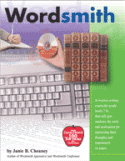 Wordsmith
by Janie B. Cheaney - For young people who want to improve their writing skills,
step-by-step instructions are provided that will help any writer improve his
techniques. The introduction provides a brief review of grammar followed by
instruction on building stronger sentences, exercise in descriptive and
narrative writing, creating dialogue, story writing, and writing from a
particular point of view. Plus, the essential skills of every good writer,
practice in proofreading and revising. Wordsmith
by Janie B. Cheaney - For young people who want to improve their writing skills,
step-by-step instructions are provided that will help any writer improve his
techniques. The introduction provides a brief review of grammar followed by
instruction on building stronger sentences, exercise in descriptive and
narrative writing, creating dialogue, story writing, and writing from a
particular point of view. Plus, the essential skills of every good writer,
practice in proofreading and revising.Paper, 106 pages. Ages 12+. #3185X $16.00 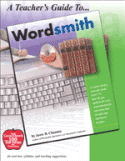 A
Teacher's Guide to Wordsmith by Janie B. Cheaney - Provides the answers
to review quizzes found in the above Wordsmith book, as well as an
overview, syllabus, and teaching suggestions. A
Teacher's Guide to Wordsmith by Janie B. Cheaney - Provides the answers
to review quizzes found in the above Wordsmith book, as well as an
overview, syllabus, and teaching suggestions. Includes a week-by-week suggested plan of study (based on 36 weeks). Paper, 45 pages. #3192 $7.00 |
|
Home |
Contents |
Contact Us |
Ordering/Shipping | Privacy
Statement |
|
|
For a lifetime of learning fun! |
If you are unable to see the blue navigation
buttons below, go to Contents for text links.
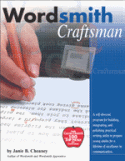 Wordsmith
Craftsman by Janie B. Cheaney - The third and last of the Wordsmith
series focuses on building, integrating, and polishing practical writing skills.
This self-directed program allows students to take charge of their assignments
and schedules. Wordsmith
Craftsman by Janie B. Cheaney - The third and last of the Wordsmith
series focuses on building, integrating, and polishing practical writing skills.
This self-directed program allows students to take charge of their assignments
and schedules. Strong in preparing the student for college, Part 1 addresses practical, everyday writing: notes, outlines, personal correspondence, summaries, business letters and reports. Part 2 focuses on the power of language: paragraphs (principles, types, and organization), writing techniques, and developing a personal writing style. Part 3 concentrates on essay writing: descriptive, narrative, expository, and persuasive essays. Wordsmith equips young adults for a lifetime of excellence in communication skills. Paper, 118 pages. Ages 15+. #3208 $16.00 |
|
Home |
Contents |
Contact Us |
Ordering/Shipping | Privacy
Statement |
|
|
For a lifetime of learning fun! |
If you are unable to see the blue navigation
buttons below, go to Contents for text links.
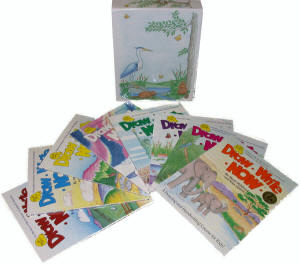
Draw-Write-Now Series
By popular demand, we are now carrying Draw Write Now, a series of books that contains simple drawing and handwriting lessons for young children.
Each book is 64-pages long and includes 3 unit studies, with a total of 21 step-by-step drawing lessons in each book. Four short, topic-related sentences are included with each lesson and may be copied by the learner in manuscript, cursive, or italic - whatever style they are learning - for handwriting practice; or they can be used as a starting point for creative writing, reports or journaling.
Each book also includes factual information on each topic, recommended book lists, and numerous ideas to spark a learner's imagination.
Recommended for ages 5-9.
| #0712 Book One: On the Farm |
|
|
| #0729 Book Two: Christopher Columbus |
|
|
| #0737 Book Three: Native Americans, Pilgrims |
|
|
| #0745 Book Four: The Polar Regions |
|
|
| #0753 Book Five: The United States |
|
|
| #0761 Book Six: Animals and Habitats |
|
|
| #077X Book Seven: Animals of the World |
|
|
| #0788 Book Eight: Animals of the World, Pt 2 |
|
Buy the boxed set of all 8 books and save even more!
#0798 Draw-Write-Now boxed set $109.99
$82.99
|
Home |
Contents |
Contact Us |
Ordering/Shipping | Privacy
Statement |
|
|
For a lifetime of learning fun! |
If you are unable to see the blue navigation
buttons below, go to Contents for text links.
 Writing
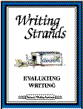
Strands by Dave Marks Writing
Strands by Dave MarksThe goal of this series is to help youngsters become skilled in the following four modes of writing: 1) argumentative 2) explanatory 3) creative and 4) research and report. The series does not focus on grammar skills but instead shows children how to
communicate through their writing. At each level, the learner follows directions
that focus on specific abilities and learns to work independently. The work is
broken up into manageable pieces that progress over time. Each assignment
produces a report, an essay or a piece of fiction. I find the author, Dave Marks, to be very respectful of children and their innate desire to learn. Some of the principles that he followed when writing these guides: every person can learn to express ideas and feelings in writing; there is no one right way to write anything; the ability to write is not an exercise of a body of knowledge that can be learned like a list of vocabulary words; all student writing efforts are worthy of praise.
|
|
Home |
Contents |
Contact Us |
Ordering/Shipping | Privacy
Statement |
|
|
For a lifetime of learning fun! |
If you are unable to see the blue navigation
buttons below, go to Contents for text links.
| Italic Handwriting Series I have listed the publisher's recommended grade level in parentheses, but the books themselves do not list a grade level. I like this because both our children (ages 8 and 12 when they started using the books) started with Book A. I think it would have bothered our son if the books had been labeled with a grade level. Our 12-year-old moved through the books more quickly than our 8-year-old and is almost two books ahead of her now. The style is different from the kind of printing either of our children was doing, so I think starting with Book A was useful for them. They also like the progressive repetition, and the writing becomes progressively smaller as they move through the series. Certainly, other learners may prefer to start later in the series (cursive begins with Book C) or do fewer of the exercises. By Barbara Getty and Inga Dubay. Paper, consumable.
|
|
Home |
Contents |
Contact Us |
Ordering/Shipping | Privacy
Statement |
|
|
For a lifetime of learning fun! |
If you are unable to see the blue navigation
buttons below, go to Contents for text links.
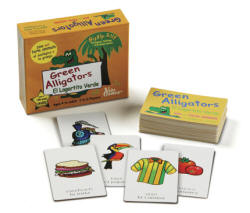 Green Alligators: Zoo and Farm Animals
(El Lagartito Verde: el zoologico y la granja) - The Giggly-Silly
bilingual descriptive word game! No reading required. Pictures are identified to
encourage early readers of both English and Spanish. Green Alligators: Zoo and Farm Animals
(El Lagartito Verde: el zoologico y la granja) - The Giggly-Silly
bilingual descriptive word game! No reading required. Pictures are identified to
encourage early readers of both English and Spanish. Green Alligators is that wonderful little "I'm thinking of" kind of card game, but this one has pictures so you can't change your mind part way through the game! Play with your little one while doing other things around the house; just take a look at your card and start giving clues. Your little one will delight in trying to guess what your card is. Then it is the child's turn to give clues. It is a non-competitive activity for 2 players, or it becomes competitive when the "big kids" try to out-guess the others! Ages 4 and up, 2 to 4 players. #307AX $10.00 |
|
Home |
Contents |
Contact Us |
Ordering/Shipping | Privacy
Statement |
|
|
For a lifetime of learning fun! |
If you are unable to see the blue navigation
buttons below, go to Contents for text links.
 Quiddler:
The Short Word Game Because words, like at, is, of, ax, and zoo can lead to
winning, readers of all ages can play and win. There are bonuses for both short
and long words. You simply combine all the cards in your hand into words. The
beautiful letter design on the cards is based on Celtic artwork. 1999 Parents'
Choice Award winner, and it has received kudos from many homeschoolers.
Quiddler:
The Short Word Game Because words, like at, is, of, ax, and zoo can lead to
winning, readers of all ages can play and win. There are bonuses for both short
and long words. You simply combine all the cards in your hand into words. The
beautiful letter design on the cards is based on Celtic artwork. 1999 Parents'
Choice Award winner, and it has received kudos from many homeschoolers.
1-8
players, ages 8+.
Save even more with the
SET FUNPak!
#9150 $12.00 $10.99
|
Home |
Contents |
Contact Us |
Ordering/Shipping | Privacy
Statement |
|
|
For a lifetime of learning fun! |
If you are unable to see the blue navigation
buttons below, go to Contents for text links.
Rummy
Roots: English Vocabulary Building Games - Our whole family had fun with this
card game. After playing, the kids became very aware of all the words in our language that
are based on Greek and Latin. "Hey, mom, bicycle-tricycle, two wheels-three
wheels!" Exclamations like that would come from the back seat of our car on the way
to the post office or from the kitchen table as we ate breakfast. It is designed for 2-4
players, ages 8-adult (our 6-year old played, with help. We also copied the vocabulary
list so everyone could have one for reference).
Rummy Roots teaches 42 Greek and Latin roots, alphabetizing, dictionary
skills, vocabulary and
more using rules based on popular card games like Go Fish. It is fun and challenging, and there are several games on different
levels. Play is enhanced by combining Rummy Roots with More Rummy Roots (see
below).
Ages 8-adult. For 2-4 players.
Rummy Roots #RR1 $15.95
Out of stock.
More Roots:
English Vocabulary Building Games - Ready to learn more? More Roots continues along in the same format as
Rummy Roots (above) and
introduces new Greek & Latin roots to increase your knowledge and skill
level.
There are several games on various levels so it's fun for a variety of ages and
abilities.
Ages 8-adult. For 2-4 players.
More Roots #MRR $15.95
|
Home |
Contents |
Contact Us |
Ordering/Shipping | Privacy
Statement |
See our college section for Vocabulary Cartoons, and Tooth and Nail
|
Home |
Contents |
Contact Us |
Ordering/Shipping | Privacy
Statement |
|
Home |
Contents |
Contact Us |
Ordering/Shipping | Privacy
Statement |
|